Where will you ring in 2011? From fireworks at the Eiffel Tower to watching the ball drop in Times Square, the opportunities for revelry are endless (admittedly, most involve champagne and fireworks).
Celebrating the beginning of another year in another country is an experience you will never forget. Here are some top global New Year’s Eve celebrations to consider (as well as the expressions you’ll need to really get into the spirit!):
Brazil
Head to Copacabana Beach for one of the most impressive New Year’s Eve fireworks displays in the world. Dress in white (as is the Brazilian custom) and get to the beach early to enjoy the crowded revelry (and to find a place to watch the fireworks from). (“Happy New Year” in Portuguese is “Feliz Ano Novo.”)
China
Solana Blue Harbor Shopping Park in Beijing hosts rock concerts and fireworks display on New Year’s Eve. Be ready for massive crowds. (“Happy New Year” in Chinese is “Xin Nian Hao.”)
Denmark
Copenhagen City Hall is definitely where you should be when the clock strikes midnight. Celebrate with the Danes while watching an impressive fireworks display. (“Happy New Year” in Danish is “Godt Nytår.”)
France
Parisians pack into the Champs-de-Mars (the large grassy area across from the Eiffel Tower) to witness a remarkable fireworks show (timed to music) when the clock strikes twelve. Bundle up or have some champagne to help you stay warm. (“Happy New Year” in French is “Bonne Année.”)
Scotland
Edinburgh’s Princes street is the place to be on New Year’s Eve. Have a drink (or several) in one of the many pubs and eateries in this area and then stumble out onto the street before midnight to witness the celebratory cannon shot followed by a fireworks display.
Portugal
Funchal Harbor on the island of Madeira (just off the coast of Portugal) hosts one of the world’s largest fireworks displays (it’s mentioned in the Guinness Book of World Records). (“Happy New Year” in Portuguese is “Feliz Ano Novo.”)
Indonesia
Head to the Statue of Welcome fountain to watch fireworks during New Year celebrations in Jakarta. (“Happy New Year” in Indonesian is “Selamat Tahun Baru.”)
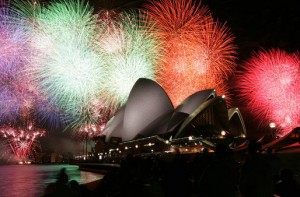
[caption id="attachment_4781" align="alignright" width="300" caption="New Year's Even Fireworks over the Sydney Opera House (Australia)"]
[/caption]
Germany
The famous Brandenburg Gate is where you should go to see the most impressive fireworks display in Germany. (“Happy New Year” in German is “Ein Gutes Neues Jahr.”)
Taiwan
Have you ever seen fireworks explode off the top of a skyscraper? This is what you can expect to experience on New Year’s Even in Taipei City. They
set off fireworks from the world's tallest completed skyscraper, Taipei 101. (“Happy New Year” in Chinese is “Xin Nian Hao.”)
Singapore
Head to Singapore’s financial district to watch fireworks and welcome the New Year in style. (You’ll be understood with “Happy New Year” in Singapore, but if you want to give it a whirl in Malay, it’s “Selamat Tahun Baru.”)
Australia
Fireworks explode each New Year’s at midnight over the Sydney Harbor Bridge and Opera House. A spectacular sight.
Don’t have the funds to jet off to an exotic locale for New Year’s Eve? Not to worry. You can still have an international experience (and shout the new expressions you learned) from the comfort of your own home. CNN and several other cable channels cover New Year’s celebrations from around the world.
Happy 2011!
 spend less than Y25 on food in some of China's most remote locations, while your food bills may rise to between Y40 and Y70 a day in the more populated areas.
You can save cash anywhere by remembering that tipping is not expected anywhere in China. Many mid to top end eateries will sneakily get around this by adding a hefty service charge to your bill, but you shouldn’t have such a problem at more modest eateries.
Most travelers would not want to miss the excitement of China's big cities, and nor should they. But with many key attractions like The Great Wall of China and the historic Leshan Dafo Buddha lying further afield, it's certainly worth saving cash and spending some time out of China's big smoke.
spend less than Y25 on food in some of China's most remote locations, while your food bills may rise to between Y40 and Y70 a day in the more populated areas.
You can save cash anywhere by remembering that tipping is not expected anywhere in China. Many mid to top end eateries will sneakily get around this by adding a hefty service charge to your bill, but you shouldn’t have such a problem at more modest eateries.
Most travelers would not want to miss the excitement of China's big cities, and nor should they. But with many key attractions like The Great Wall of China and the historic Leshan Dafo Buddha lying further afield, it's certainly worth saving cash and spending some time out of China's big smoke.

 [/caption]
Heilongjiang's capital is a natural site for the festivities, as it gets the harsh, cold winds from Siberia. In winter the temperature is an average of -16.8°C, but it can be as cold as -38°C if you’re unlucky!
But don't let the freezing
[/caption]
Heilongjiang's capital is a natural site for the festivities, as it gets the harsh, cold winds from Siberia. In winter the temperature is an average of -16.8°C, but it can be as cold as -38°C if you’re unlucky!
But don't let the freezing  [/caption]
All rooms evoke the essence of old Shanghai, with silk print wallpaper and whimsical Asian artifacts and furniture creating the atmosphere of the Orient. The plush canopy beds are another nod to the past, as their design was inspired by traditional Chinese wedding beds. Perhaps sleeping in them will give your relationship the bliss of happy Asian newlyweds!
The contemporary-styled bathrooms are luxuriously large, the perfect place for relaxing after a busy day sightseeing. A glass wall allows you to gaze out at the Huangpu River while you soak in the freestanding tub.
Rooms at Hotel Indigo Shanghai start from 1580 Chinese Yuan, which is equivalent to around $240 US.
[/caption]
All rooms evoke the essence of old Shanghai, with silk print wallpaper and whimsical Asian artifacts and furniture creating the atmosphere of the Orient. The plush canopy beds are another nod to the past, as their design was inspired by traditional Chinese wedding beds. Perhaps sleeping in them will give your relationship the bliss of happy Asian newlyweds!
The contemporary-styled bathrooms are luxuriously large, the perfect place for relaxing after a busy day sightseeing. A glass wall allows you to gaze out at the Huangpu River while you soak in the freestanding tub.
Rooms at Hotel Indigo Shanghai start from 1580 Chinese Yuan, which is equivalent to around $240 US.
 [/caption]
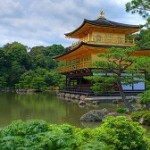
Changeokgung Palace is one of South Korea's five grand palaces, but it's the one that most princes of the Joseon Dynasty liked the best. It's not hard to see why. Its secret garden was a favorite place for archery games and fireworks displays, with its lotus ponds and landscaped lawns. The building itself strives to blend in to its natural surrounds, a revolutionary idea for 1405. Sadly much of the palace was destroyed during the Japanese occupation of Korea, so only about a third of its structures remain.
It may not have the rich history of the other buildings we’ve mentioned, but that's no reason to dismiss Coconut Palace in The Philippines. This palace was built under the order of former First Lady Imelda Marcos for Pope John Paul II's 1981 visit. The octagon-shaped building is an excellent example of Filipino design, with its body of hardwood and materials derived from the coconut. There are even more coconuts inside, with coconut chandeliers and furniture inlaid with coconut shells. This quirky building is easily accessible for tourists as it's part of Manila Bay's cultural center complex.
So make sure you get out of the bustling cities while you're traveling around Asia; there are some stunning architectural marvels just waiting to be explored.
[/caption]
Changeokgung Palace is one of South Korea's five grand palaces, but it's the one that most princes of the Joseon Dynasty liked the best. It's not hard to see why. Its secret garden was a favorite place for archery games and fireworks displays, with its lotus ponds and landscaped lawns. The building itself strives to blend in to its natural surrounds, a revolutionary idea for 1405. Sadly much of the palace was destroyed during the Japanese occupation of Korea, so only about a third of its structures remain.
It may not have the rich history of the other buildings we’ve mentioned, but that's no reason to dismiss Coconut Palace in The Philippines. This palace was built under the order of former First Lady Imelda Marcos for Pope John Paul II's 1981 visit. The octagon-shaped building is an excellent example of Filipino design, with its body of hardwood and materials derived from the coconut. There are even more coconuts inside, with coconut chandeliers and furniture inlaid with coconut shells. This quirky building is easily accessible for tourists as it's part of Manila Bay's cultural center complex.
So make sure you get out of the bustling cities while you're traveling around Asia; there are some stunning architectural marvels just waiting to be explored.
 If that hasn't calmed you, consider a soak in the Jacuzzi or a treatment at the city's first Anantara spa. The spa's treatments are a real experience as they use ancient techniques from China, Thailand, and India. Emphasis is placed on the beneficial powers of natural products including moisturizing avocado, purifying ginger, and healing volcanic stone.
Personally I can't imagine wanting to work up a sweat with all this pampering around, but if you do you can work out at the state of the art fitness center. There's high tech gym equipment, a sauna and steam room, and lap pool.
A night at the PuLi Hotel and Spa doesn't come cheaply, with rates starting from $500 US a night. However, if you want to come away from your
If that hasn't calmed you, consider a soak in the Jacuzzi or a treatment at the city's first Anantara spa. The spa's treatments are a real experience as they use ancient techniques from China, Thailand, and India. Emphasis is placed on the beneficial powers of natural products including moisturizing avocado, purifying ginger, and healing volcanic stone.
Personally I can't imagine wanting to work up a sweat with all this pampering around, but if you do you can work out at the state of the art fitness center. There's high tech gym equipment, a sauna and steam room, and lap pool.
A night at the PuLi Hotel and Spa doesn't come cheaply, with rates starting from $500 US a night. However, if you want to come away from your  [/caption]
The years spent training should be enough for you to raise the sort of cash you'll need, because this expedition is not cheap. An independent voyage can cost as much as $25, 000, while a package tour will set you back around $60, 000. It seems expensive, but $10, 000 of this goes to climbing permits alone. When you add travel, provisions, oxygen, insurance, and equipment into the equation it's easy to see how the dollars add up.
May and October are the best times to scale Mount Everest, as this avoids winter snowstorms and summer monsoons.
The dangerous journey is probably not one you want to take alone. Tour companies including
[/caption]
The years spent training should be enough for you to raise the sort of cash you'll need, because this expedition is not cheap. An independent voyage can cost as much as $25, 000, while a package tour will set you back around $60, 000. It seems expensive, but $10, 000 of this goes to climbing permits alone. When you add travel, provisions, oxygen, insurance, and equipment into the equation it's easy to see how the dollars add up.
May and October are the best times to scale Mount Everest, as this avoids winter snowstorms and summer monsoons.
The dangerous journey is probably not one you want to take alone. Tour companies including  [/caption]
The Shine for Sheraton spas sound like easy places to relax, with their marble, mahogany, and polished metal surrounds rendered in warm cream, burnished gold, and cobalt blue shades. These hues and materials were specifically chosen to create an atmosphere that feels playful, yet opulent.
"Introducing the Shine spa experience across our portfolio on the heels of our $6 billion revitalization effort will be an invaluable, welcome addition to the Sheraton guest experience," Hoyt H. Harper II, senior vice president for Sheraton,
[/caption]
The Shine for Sheraton spas sound like easy places to relax, with their marble, mahogany, and polished metal surrounds rendered in warm cream, burnished gold, and cobalt blue shades. These hues and materials were specifically chosen to create an atmosphere that feels playful, yet opulent.
"Introducing the Shine spa experience across our portfolio on the heels of our $6 billion revitalization effort will be an invaluable, welcome addition to the Sheraton guest experience," Hoyt H. Harper II, senior vice president for Sheraton,  [/caption]
For interesting animals and plants, look to the Bonin Islands off the Japanese coast. These 30 different islands were formed long ago by an ancient volcano, and have since evolved in their own unique ways. The islands are home to more than 14 different animals and 100 unique plant species including the protected Ogasawara damselfly, the Japanese Woodpigeon, and the Bonin Flying Fox. Access is difficult though, so you’ll need to be keen. The Ogasawara Maru liner leaves from Tokyo Bay four or five times each month, and takes around 25 hours to reach its destination.
Tourists can feel like royalty traveling on the backs of
[/caption]
For interesting animals and plants, look to the Bonin Islands off the Japanese coast. These 30 different islands were formed long ago by an ancient volcano, and have since evolved in their own unique ways. The islands are home to more than 14 different animals and 100 unique plant species including the protected Ogasawara damselfly, the Japanese Woodpigeon, and the Bonin Flying Fox. Access is difficult though, so you’ll need to be keen. The Ogasawara Maru liner leaves from Tokyo Bay four or five times each month, and takes around 25 hours to reach its destination.
Tourists can feel like royalty traveling on the backs of